
The coastline of Portugal

“Onde a terra se acaba e o mar começa” Luís Vaz de Camões
"Ahol a szárazföld végződik és a tenger kezdődik." Így szól az idézet a Luís Vaz de Camões, portugál költőnek állított emléktáblán Cabo da Roca-nál, a kontinentális Európa legnyugatibb pontjánál. Ez a mondat kellőképp tömören és képiesen írja le Portugália Európa és a Világ térképén elfoglalt helyét. Kilenc napos utunk során központi szerepet kapott a portugál óceánpart, ezért is választottam ezt az idézetet a bejegyzés kezdéseként. A Lisszabonban bérelt Fiat Tiponkkal bejártuk Portugália legdélebbi régióinak - Alentejo és Algarve - partszakaszait, majd öt napot töltöttünk a fővárosban, amely a Tejo folyó torkolatánál helyezkedik el.

When the big body of water meets the land. The coast of the Atlantic near Porto Covo.
Amikor a hatalmas víztömeg találkozik a szárazfölddel. Az Atlanti-óceán partja Porto Covo közelében.

From the north to the south: Sintra, Cabo da Roca, Lissabon, Cascais, SInes, Porto Covo, Quarteira, Faro
Északról délre: Sintra, Cabo da Roca, Lissabon, Cascais, SInes, Porto Covo, Quarteira, Faro
Day 1 Sines


On the road across the Vasco da Gama bridge to Sines, where the famous explorer was born. The rhythm and the shadow play of the well designed and finely detailed lamp posts on the bridge is a nice example of civil engineering. The city of Sines lies in the region of Alentejo, which means "beyond the river Tejo".
Autóval átszelve a Tejo folyót a Vasco da Gamaról elnevezett hídon Sines felé, ahol a híres felfedező született. A híd gondosan tervezett lámpaoszlopainak részletei, ritmusa és árnyjátéka a mérnöki tevékenység egy szép példája. Sines városa Alentejo régióban helyezkedik el, melynek neve annyit jelent "túl a Tejo folyón".
The narrow roads of the old town of Sines, where once Vasco da Gama lived his daily life.
Sines óvárosának szűk utcái, ahol egykor Vasco da Gama, Portugália híres felfedezője élt.

The traditionally made roof covering by the native people overgrown by the nature. It shows that the country has once seen better days in terms of prosperity and economical well-being.
A hagyományos tetőfedés amelyet benőtt a természet. Egyben példája annak, hogy az ország a gazdasági jólét szempontjából látott már szebb napokat is.

The colorful coastline of the city of Sines with the oceanfront dwelling houses.
Sines városának színes partszakasza az óceánra néző lakóházak sorával.
Day 2 Faro

A perfect start to the day. One of the best places where i have ever had breakfast. On the shores of Sines with the view of the endless Atlantic ocean. Thereafter we took the car and headed off to Faro, to the southernmost part of Portugal, to the Algarve region.
Tökéletes indítása a napnak, az egyik legszebb hely ahol valaha reggeliztem. Sines partszakasza a végtelennek tűnő Atlanti óceán látványával. Reggeli után még délebbre vettük az irányt, mégpedig Faroba, amely Portugália legdélebbi régiójában, Algarveban fekszik.

Just us - on the left Minh, on the right Betti and it was me who made the picture - and our rented Fiat Tipo on the road under the bright blue Portuguese sky.
Csak mi - bal oldalon Minh, jobb oldalon Betti, én pedig a képet készítettem - és a kölcsönzött Fiat Tipo. Pihenő a ragyogóan kék portugál égbolt alat.

A road toll gate must not necessarily be ugly. Here is a well-engineered example on the motorway of Algarve.
Egy fizetőskapunak nem feltétlenül kell csúnyának lennie. A képen egy gondosan megtervezett példa Algarve autópályáján.

The rhythm of the facade. The Bishop's Palace -Paço Episcopal- of Faro on the Largo da Sé. Just 11 years after the completion at the end of the 16th century it had to survive a briton attack under the reign of Queen Elisabeth I. In the year of 1755 an earthquake and tsunami caused massive damages as well. However, with its white walls and traditional roof tiles and with the rhythm of the roof structure and window framings, it still dominates the square. The row of orange trees in front of it supplement the architectural attitude.
A homlokzat ritmusa. A Püspöki Palota -Paço Episcopal- Faro óvárosában, a Largo da Sé névű téren. Csupán 11 évvel az építkezés befejezése után a 16. század végén túlélt egy brit támadást I. Erzsébet királynő uralkodása alatt. 1755-ben egy földrengés és cunami okozott nagy pusztítást. Mindezek ellenére, fehér falaival, hagyományos portugál cserépfedésével, valamint a tetőszerkezet és az ablakkeretezések ritmusával még mindig meghatározó eleme a térnek. A narancsfák sora a ház előtt szépen követi az építészeti koncepciót.
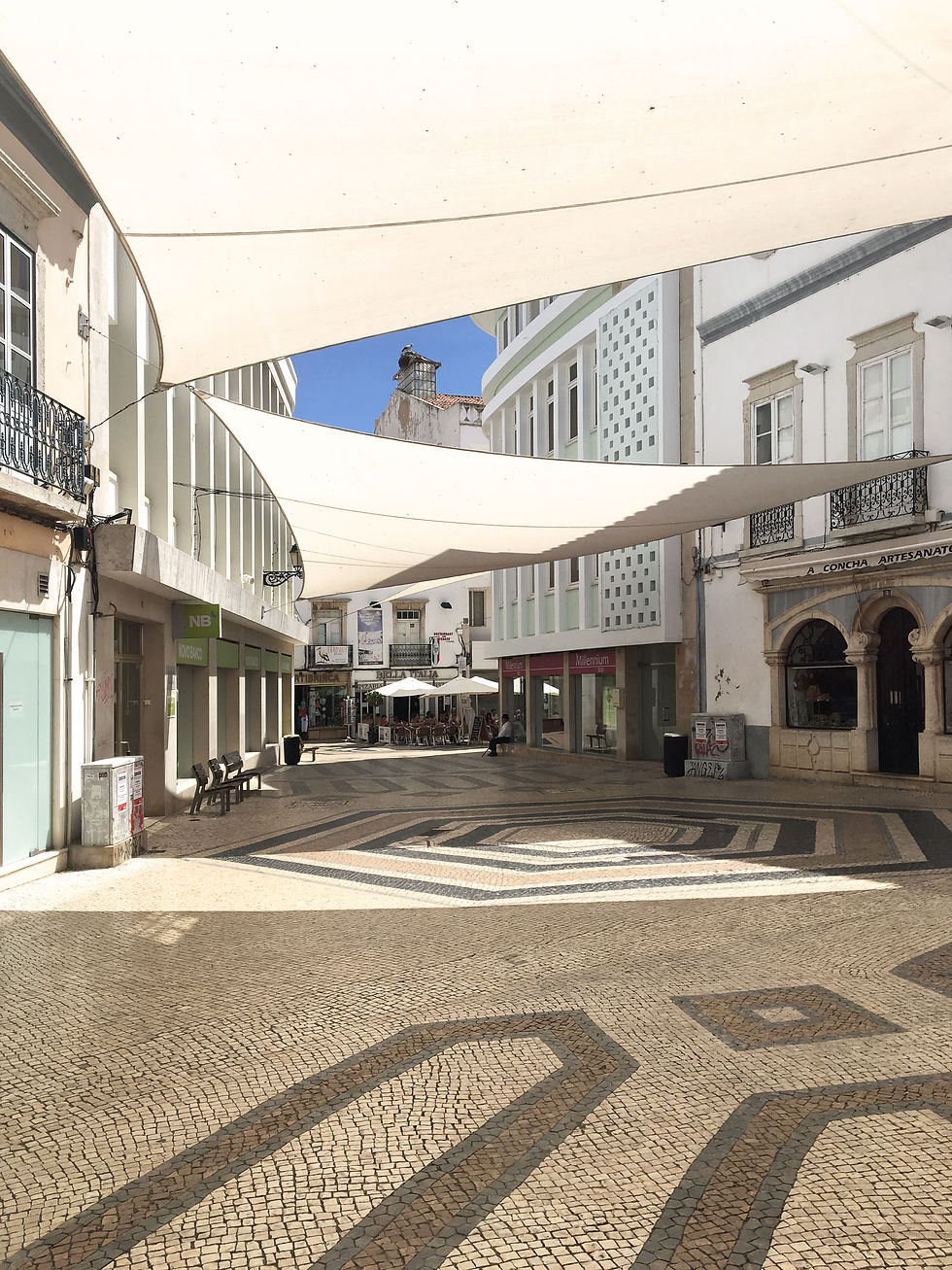
The shading canopy is a typical view across the inner city. It is usually streched above the streets beetween the houses. It the southernmost city of Portugal, the inhabitants must protect themselves from the high UV level of the Sun. The ornate cobble stone is a traditional paving of the streets throughout Portugal.
Az árnyékoló ponyva tipikus látvány a város utcáin barangolva. Általában az utca két oldalán álló házak közé feszítik ki. Portugália legdélebbi városában a lakók így védekeznek a Nap magas UV sugárzása ellen. A díszes macskakő utcaburkolat hagyományosan egész Portugáliára jellemző.

On our way back to Sines after having a break on the coast of Quarteira. A beautiful sunset with the different layers of south Portuguese hills in the background. The silhouettes of cork trees are also an essential part of the landscape. The cork is an important material in the industry of Portugal. The land is the biggest producer of cork in the world, it is the main export product.
Úton vissza Sinesbe, miután tartottunk egy kis pihenőt a quarteirai tengerparton. Gyönyörű naplemente a dél-portugál domboldal különböző rétegeivel a háttérben. A parafa fák sziluettje jelentős eleme a tájnak. A portugál ipar fontos részét képezi a parafa feldolgozása. Portugália a világ legnagyobb parafa termelője, ez az ország fő exportterméke.
Day 3 Porto Covo

A seagull is flying over the rocks of the Portuguese coastline under the blue sky.
Egy sirály repül a portugál partszakasz sziklái felett a ragyogó kék égbolt alatt.

Betti posing on the windy coast on the way to Porto Covo. The tiny village near the ocean appears in the background. Porto means port and Covo refers to a traditional fishing net, used to capturing lobsters and crabs. That shows the settlements tight connection with the ocean.
Betti pózol az óceánparton, úton Porto Covo felé. Az apró óceánközeli falu házai feltűnnek a háttérben. A település nevében a Porto kikötőt jelent, a Covo pedig egy hagyományos halászhálóra utal, melyet rákhalászatra használtak. Ez is mutatja a falucska óceánnal való szoros kapcsolatát.

Given this bright blue southern sky, it is no wonder why the natives chose the blue paint to decorate their houses. The blue footings and window frames finely match the plain white plastered walls. All of the settlements houses still look like that today. The carefully formed chimneys are also nicely integrated in the volumes of the houses.
Elnézve a ragyogóan kék égboltot, nem csoda hogy a helyiek ezt a színt válaszották házaik dekorálására. A kék színű lábazatok valamint ablakkeretezések jól mutatnak az egyszerű, fehérre vakolt falakon. A település szinte összes háza még ma is hasonlóan néz ki. A gondosan formált kéményeket szintén szépen integráltál az épülettömegbe.

Having lunch in such a scenery, feeling the wind caused by the Atlantic on your skin, on the open terrace of this oceanfront restaurant is invalueable. A wooden path leads us down to the shore, where you can have your freshly grilled sardines.
Egy ilyen festői környezetben ebédelni az óceánparti étterem fedett-nyitott teraszán, bőrödön érezve az Atlanti-óceán által okozott szelet, felbecsülhetetlen. Egy fa pallókkal kirakott ösvény vezet le a partra, ahol frissen grillezett halak várják a túrázót.
Day 4 Cabo da Roca

A lonely sailing boat across the vast Atlantic Ocean. Given the circumstances, sailing is naturally a great tradition in this land. With sharp eyes, from Cabo da Roca- the westernmost point of continental Europe- you could see the continent of America on the other side of the ocean.
Egy magányos vitorlás hajó a hatalmas Atlanti-óceánon. A körülményekhez méltan, a vitorlázásnak nagy hagyománya van az országban. Cabo da Roca a kontinentális Európa legnyugatibb pontja. Elég éles szemekkel láthatnánk Amerikát a túloldalon.

One of our favourite pictures just shows how windy it is on the coastline, even on a bright, sunshiny day. In these couple of days we had just made a car trip from the southernmost to the westernmost point of Portugal.
Egyik kedvenc képünk mutatja mennyire szeles tud lenni az idő az óceán mentén, még szép időben is. Pár nap leforgása alatt eljutottunk Portugália legdélebbi, majd legnyugatabbra fekvő pontjára.
Comments